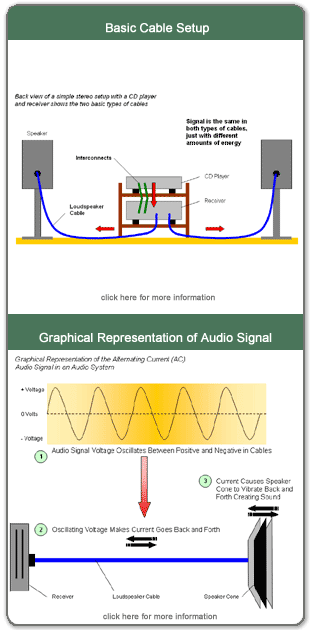
to realize that both types
of cables are carrying the same information, just with different
amounts of energy.
Interconnects carry a signal with very little energy. These cables
only need just enough energy to convey the information from the
source, for example a CD player, to the amplifier. The low energy
requirement means that the signal in interconnects has very little
current (usually in the range of thousandths of an amp).
Loudspeaker cables on the other hand, carry a large amount of energy.
All of the energy required to move the speaker cones and make sound
must come through the loudspeaker cables. Because of the high-energy
requirement in these cables the current is relatively high (currents
can reach 10 amps or more).
The very basic reason why audio cables are important is because
they change the signal going through them. There are two different,
fundamental ways that an audio cable can change the signal. The
cable itself can change the signal, or the cable can allow outside
sources of energy to change the signal.
In order to understand how these two situations can occur, some
basic background electrical knowledge is needed.
Signals in all types of wires are conveyed by the combination of
voltage and current. Every signal has some amount of voltage and
some amount of current. The larger the difference in voltage between
two places, say the beginning and the end of a cable, the larger
the amount of current, and vice-versa. The direct analogy to voltage
and current is the flow of water through a hose. The amount of water
flowing through the hose is analogous to current. The water pressure
in the hose is analogous to voltage. The higher the amount of water
pressure, the more water will flow through the hose. The higher
the amount of voltage, the more current will flow through the wire.
Every cable has a set of electrical properties that can be measured
using standard electrical testing equipment. The three most basic
properties are resistance, capacitance and inductance. While a detailed
description of these three different electrical properties is outside
the scope of this article, a basic description of the relevant effects
of these three properties can be given.
• Resistance opposes current. The higher the resistance the
greater the amount of energy that is removed from the current and
turned into heat.
• Capacitance opposes changes in voltage. If a voltage is
increasing, capacitance will cause the voltage to increase more
slowly. If a voltage is decreasing, capacitance will cause the voltage
to decrease more slowly.
• Inductance opposes changes in current. If current is increasing,
inductance will cause the current to increase more slowly. If current
is decreasing, inductance will cause the current to decrease more
slowly.
The final piece of background knowledge that is needed for this
article is what the audio signal looks like. If one were to take
the speaker cover off a speaker to look at the speaker cone while
music is playing, you would see that it is moving back and forth.
In order to move the speaker cone back and forth, the electrical
signal must push and then pull the cone in rapid and repeating fashion.
This is accomplished by having an Alternating Current, or AC.
Alternating Current simply means that the voltage oscillates between
positive and negative. Because the voltage drives the current, this
means that the current also goes positive and negative. In other
words, the current is going back and forth in the wire, just like
the speaker cone. The subtle variations in how fast the voltage
and current go back and forth creates the different sounds that
we hear when listening to music.
How a cable itself affects the audio signal
Now, going back to the ways that the cable itself can change the
signal going through it, let’s consider both types of cables
separately.
As stated previously, interconnect cables carry a very small amount
of current. Relative to the current the voltage is large. Because
of that fact, capacitance is important, but inductance is relatively
unimportant. As the voltage oscillates between being positive
and negative, the capacitance slows the voltage changes down, and
causes delays. This can cause audible distortion in the sound.
Because interconnects have very little current, resistance is not
much of a factor. Even an interconnect with extremely high resistance
will only remove an infinitesimally small amount of energy.
The signal in loudspeaker cables is essentially the opposite of
the signal in interconnects. Both cables have the same information,
but in loudspeaker cables, the voltage is small and the current
is large, relatively speaking. Because of the high current,
both resistance and inductance are important in loudspeaker cables.
The higher the resistance, the greater the amount of energy that
will be absorbed by the cables. The resistance will not cause any
distortion, but it will decrease the volume of the sound. The inductance
on the other hand, can cause distortion. As the current oscillates
between being positive and negative, the inductance slows the current
changes down, and causes delays.
How a cable lets outside sources of energy affect the signal
As stated previously, the second fundamental way of altering a
signal passing through an audio cable is to introduce outside sources
of energy. This outside energy is typically termed “noise”.
By definition, if any energy is absorbed by the signal, the signal
has been distorted.
There are many potential sources of noise around audio cables.
Some of the more common sources of noise, such as radio frequency
waves, are familiar to most people. When wiring up a radio, frequently
a consumer must attach an antenna. Antennae are intentionally designed
to channel radio frequency energy into a stereo. Just like an antenna,
it is entirely possible for an audio cable to pick up radio frequency
energy. If you are not intending to listen to the radio, this is
not a welcome effect.
Electronic components, electrical cords, sound waves, and even
the sun, are all capable of creating noise. Electrical cords create
electromagnetic fields around them that can transfer energy to a
cable. Sound waves create mechanical vibrations that can be transformed
into electrical energy that is added to an audio signal. Because
there are so many different types of noise, there are many methods
used to prevent a cable from picking up noise. Shielding, twisting
of conductors, and mechanical damping are all common noise protection
methods in cables.
While noise affects both interconnects and loudspeaker cables,
generally the effects are far more significant in interconnects.
This is because the signals in the interconnects have far less energy.
Since most forms of noise are inherently low energy to begin with,
this means that it is far easier for them to modify the low energy
interconnect signals than the high-energy loudspeaker cable signals.
Macro vs. Micro
The parameters discussed so far have been primarily “macro”
effects. These are for the most part the top-level parameters that
effect cables. These parameters as well as others not discussed
here also exist at a “micro” level. Taking capacitance
as an example, a given cable will have an overall capacitance that
can be measured. This overall capacitance is a “macro”
level parameter. The same cable can also be analyzed as 1000 separate
but connected pieces. Each piece will have a local capacitance.
These local parameters are “micro” effects and can have
their own impact on the signal separate from the “macro”
effects.
The impact that the “micro” level parameters have on
an audio signal is usually less than the impact of the “macro”
level parameters. However, they do still make a difference in the
signal transfer. The various ways that audio companies choose to
either mitigate or ignore these “micro” level details
is, in part, responsible for the vast array of different cable designs.
From cryogenic treatments and precious metal wires, to fine silk
insulation and fluid filled cable jackets; extreme cable designs
abound.
Will I hear the difference?
The fact of the matter is that cables do alter the sound going
through them, and that it is audible. You do not need to be an expert,
or an audiophile, to hear the difference. To demonstrate this point,
simply listen to your stereo. If you close your eyes, does it sound
like the music is being played live right in front of you? This
is what audiophiles strive for, and unless you have a very high-fidelity
system, your answer to this question will most likely be no. You
may have a hard time describing what exactly does not sound right
about your system, but you know that it doesn’t sound like
a live performance.
Of course, the reason why the music does not sound live cannot
be blamed solely on the cables. The degradation of the sound occurs
in every component of your system. However, the point here is that
even a casual listener can detect the subtle distortions that can
prevent music playback from sounding live. Improving the quality
of your audio cables will improve the sound quality of your system.
It is fairly safe to say that no matter what cable you use, the
modifications to the sound will be small. Audio cables will never
cause a listener to hear a piano when a flute is being played. However,
it is the small detail that makes all the difference between good
and bad quality sound. That is why very strong opinions are
formed about various cables.
As audio systems continue to improve in accuracy, listening to
a “live” performance in your living room gets closer
to reality. Cables are an enabling factor for advancements in audio
reproduction and can play a remarkably important role in your system.
 Download the pdf
Version of "Technical Introduction to Audio Cables"
Download the pdf
Version of "Technical Introduction to Audio Cables"
|