| Does it matter if an
audio cable is made overseas? Should I really worry about the
build quality of an audio cable? The short answer is “Yes!”
The lack of quality in some competitors’ products, and
blatant false advertising that currently exists is shocking.
The photos presented here of products that claim to be high
quality demonstrate the significant problems consumers may be
faced with.
At Pear Cable, we spend a lot of time talking about the sound
quality enabled by a cable design, but we also have a focus
on producing cables with superb build quality. Although we
don’t talk about it as much, the cable build quality
is an extremely important factor that cannot be ignored.
Just because you hook up a pair of cables and sound comes
through, doesn’t mean they are built well. Unfortunately,
many cables on the market today have dramatic flaws that may
not be easily detectable by the average consumer. In fact,
you may be shocked at just how bad some cables can be. Although
this article is by no means comprehensive, we have photographed
a few of the more common problems that can exist with poorly
made cables.
RCA Cables
We cut open shielded twisted pair interconnects from 3 major
manufacturers of cable, to determine the true build quality
of the products. Unbelievably, we found that NONE of the three
different interconnects we examined had the shields connected
to anything. These shields are supposed to be connected to
ground in order for them to function properly. Shields that
are allowed to simply “float” unconnected to the
circuit will have almost no shielding ability whatsoever.
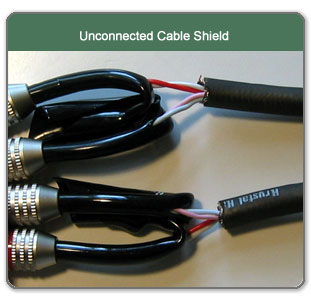
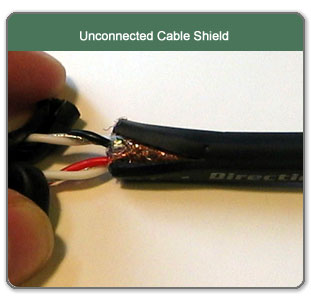
Photos of two of the offending cables are provided.
The first interconnect pictured to the right is advertised
to have “three different layers of shielding”
and that it is “one of the best cables on the market.”
After cutting back the plastic covers at the Y-junctions in
the cable, it can be clearly seen that none of the three shields
are connected to the connectors. Electrical tests confirm
that these shields are all floating, rendering them virtually
useless.
The second interconnect to the right is the highest level
offering from one of the largest car audio cable manufacturers.
It is claimed to have a “Mylar foil and OFC braided
shield” with “directional noise-drain wires”.
Cutting back the over-molding at the Y-junction reveals that
the cable does in fact have all the components claimed. In
addition, simple electrical tests confirm that the “directional
noise-drain wires”, which can be seen bundled with the
twisted pairs of wires, are connected to ground at the RCA
plugs. Unfortunately, these noise drain wires are not connected
to the shield! It is pretty hard for the wires to drain noise
if they are not attached to anything. So, again on this cable,
the shields are rendered virtually useless.
Undersized Battery Cables
The problem of manufacturers skimping on expensive copper
by removing strands from battery cables has been well known
for a long time. This false advertising is of course illegal,
and leads to safety hazards due to high current wires being
undersized for their circuits. If it hasn’t happened
already, it is only a matter of time before a vehicle catches
on fire due to overheating of battery cables that do not have
the amount of copper they claim.
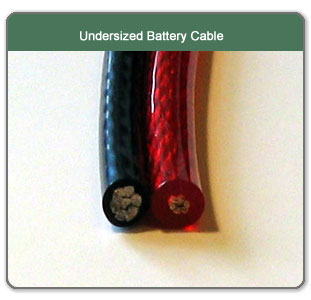
The photo of battery cables to the right shows 2 different
8 AWG power cables. The black cable on the left is a Pear
Cable with a slim line jacket rated for 600 Volts at 105 degrees
C. One of our competitors (another major manufacturer of car
audio cables) makes the red cable on the right. While the
outer diameter of the red cable is actually slightly larger
than the outer diameter of the black Pear Cable, it can be
clearly seen that the red cable does not have anywhere close
to the correct amount of copper. In fact, less than half of
the specified 8 AWG copper is present. So much for the manufacturer’s
claim: “High-quality materials, construction techniques
and the most current technologies go into each product”.
These examples are just a few of the most common problems
found with inferior quality audio cables. In addition, it
is common for speaker cables to be undersized, and for mini-spools
of cable to come with less cable than advertised. It is not
uncommon for a 30 foot spool of cable to actually contain
just 28 feet of cable.
Due to the ubiquitous use of the term “quality”,
for certain products it can seem like a differentiator without
any real meaning. We hope these photos have shown that this
is not the case with audio cables. With Pear Cable, you can
always be assured that you are receiving high quality American
made products that make a difference.
|